

Alms Giving Ceremonies in Southeast Asia are Still Kind (No matter what social media says).
Seeing monks shop, mundanely, for knock off Ring cameras in the market or swiping on a cell phone in a tuk tuk is jarring. We imagine their days are fully spent in quiet meditation and devoted prayer, noses buried in Buddhist scripture. They are, but they’re also widely integrated in the community via cultural rituals and guidance. In exchange, communities offer monks food and gifts in a daily morning ritual known as Tak Bat or the Alms Giving Ceremony. What was once an insulated community practice has now become a staple on travel itineraries, but is that a bad thing?
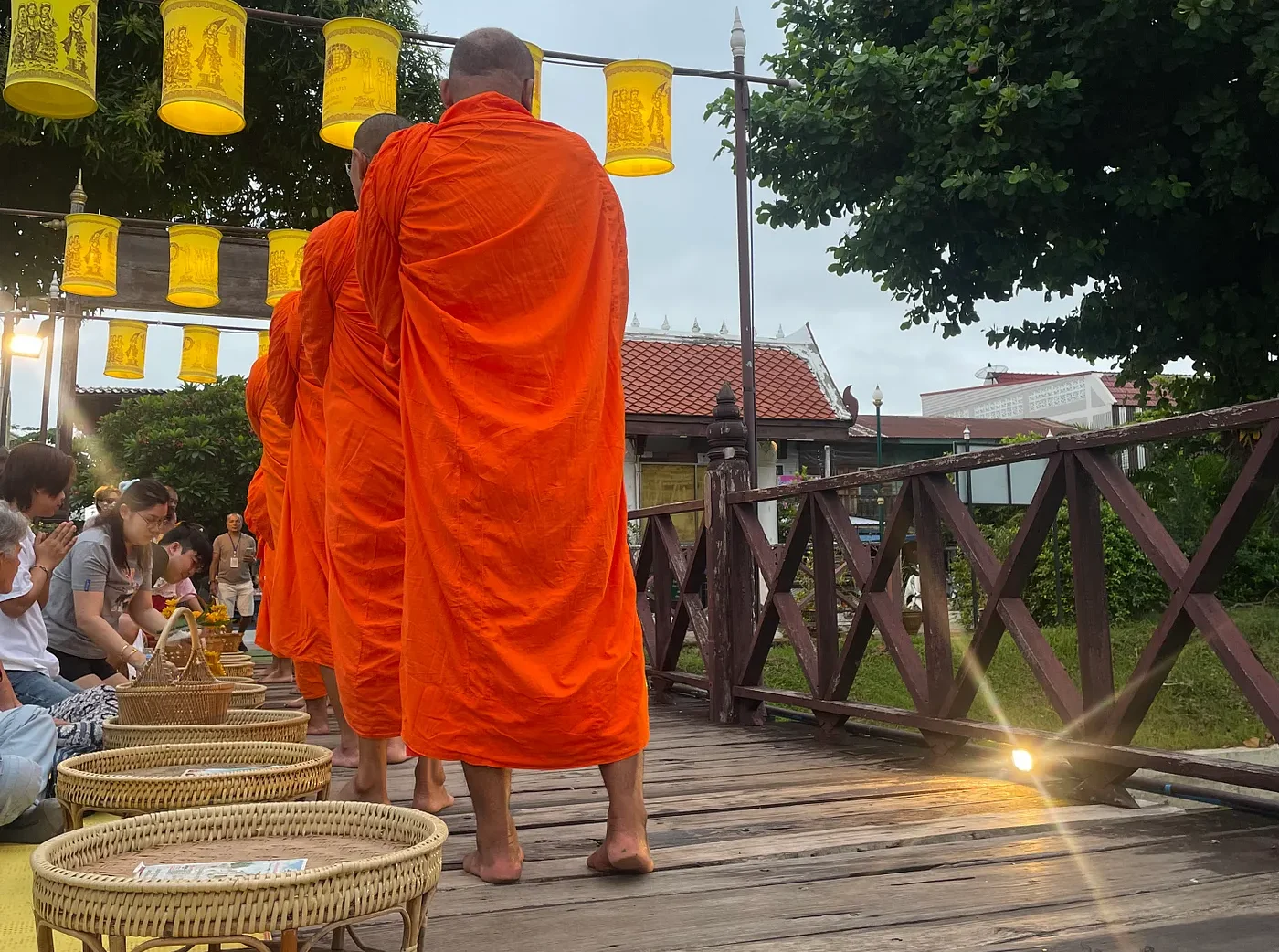
Alms Giving Ceremonies were on our slow travel itineraries in both Thailand and Laos. In Thailand, we woke up at 5am to arrive at the Wat Traphang Thong (“Temple of the Golden Lake”) in Mueang Kao before the 6:20am procession of monks accepting alms. Each day, local vendors wrap baskets for tourists to purchase and offer to monks. These ready-made packaged gifts range from a simple ฿30 THB ($0.92 USD) to an ornate ฿100 THB ($3.09 USD). Monks accept offerings in a short basket followed closely by a handler ready to collect the overflow. We purchased several small packages containing uncooked rice, water, Ovaltine, and lunch-box sized packets of cookies and Thai Goldfish crackers.

The ceremony’s path is marked by a row of wicker mats and a small tables where offerings are placed before they’re, well, offered. Like clockwork, the monks arrived in a neat row at 6:20am. Soft music guided the shuffle of bald men in tangerine dressings, heads down and basket tops up. We gently deposited the food while respectfully bowing our heads, pressed hands to our foreheads. Monks closed the ceremony by chanting a prayer for us. It was a peaceful start to the day that felt culturally immersive, gracious, reverential. A sentiment we anticipated washing over us, again, in Laos.

Luang Prabang, Laos is a UNESCO World Heritage site with more than 30 Buddhist temples, world-famous markets, photo-ready waterfalls, deep culture, and vast landscapes. We were there during the rainy season where availability of lodging was high and travel costs were low. The arrangement of interchangeable gray vans revealed the flaw in our plan — we were not the only travelers are motivated by savings.
We arrived early to locate a spot away from the crowds. Sadly, we arrived much too early, losing the mystique of the occasion by witnessing its staging. Endless stacks of squat plastic chairs were unloaded on the main street, further than our eyes could see, by local men wearied by the futility of a task they’d be executing again, in reverse, in a matter of hours. And again tomorrow.
Locals selling the packaged gifts for the ceremony were irked at the visitors, finally freed from tour buses, carrying pre-wrapped tributes in their hands that were likely supplied by the tour operator.
Huge signs whose attempt at discrete visibility served only as tripping hazards for mobile phone shutterbugs. We’d read the rules before we arrived so we knew to dress modestly, be silent, maintain distance from the monks, and avoid touching the monks or their clothing. You know, just be a responsible human.
We found a less populated street, across from 4 residential women who we desperately, silently wanted to convince that we weren’t like the other-others.

A sweet man who spoke English fielded our question about the social media outrage over monks throwing away sticky rice at the conclusion of the ceremony. He explained it was a matter of safety, that often the food is prepared and handled in ways that don’t align with their religious practices. Rather than waste food, it is collected and donated to orphanages or the unhoused.
So is it a bad thing that an insulated community practice has now an essential of component of a Southeast Asia checklist? No. Not if you approach it with curiosity, intention, and a solemnly authentic pursuit of cultural immersion.
🎬 Reading about it can’t convey the utter peace of the ceremony. Watch our experience on YouTube.